

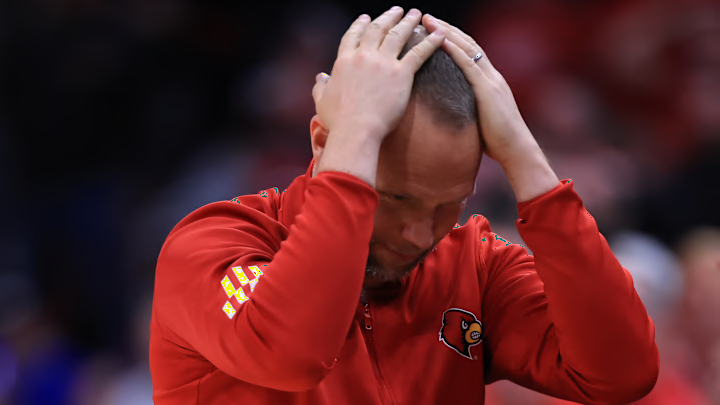
At some point, trends stop being coincidences. For Pat Kelsey, that point may already be here. While his early success at Louisville basketball has revived optimism around the program, his consistent struggles against ranked opponents are becoming too glaring to ignore — and they raise real questions about whether his offensive philosophy can hold up against elite competition.
Pat Kelsey is in his second season at the helm of Louisville basketball, taking over a program that was left in complete disarray after two forgettable years under Kenny Payne.
Louisville entered the season highly ranked and carrying even higher expectations. A win over in-state rival Kentucky only fueled the belief that this could be a Final Four-caliber team. Now, in mid-January and just 17 games into the season, that optimism has faded.
Louisville basketball fans can’t ignore this glaring trend anymore
Louisville has lost three of its last four games and sits at just 5–5 over its last 10. The Cards are also off to a 2–3 start in ACC play after finishing 18–2 in conference games a season ago.
The bigger concern, however, isn’t just this rough stretch — it’s how Louisville has fared against quality opponents. At Winthrop and Charleston, Kelsey recorded just one win against a ranked opponent. Over 12 seasons, he went 1–12 in those games, losing by an average of 13 points. The troubling part is that the same trend is continuing at Louisville.
In just a season and a half with the Cardinals, Kelsey is 4–9 against ranked teams. Louisville is no longer outmatched on paper in these games, yet the results remain largely the same — and that’s becoming increasingly concerning.
Last Season’s Warning Signs
After starting 6–5, Louisville ripped off 17 wins in 18 ACC games and reached the ACC Tournament championship game. By season’s end, the Cardinals were 27–8, but just 2–5 against ranked opponents. Those wins came against Indiana and Clemson. Indiana finished the season unranked and missed the NCAA Tournament entirely, while Clemson — whom Louisville beat twice — provided the lone truly impressive ranked victory.
That 2–5 record against ranked teams was mostly forgotten due to Louisville’s long winning streak against a weak ACC schedule. In hindsight, it should have raised more alarms. Those five losses came by an average margin of 16 points.
In those five losses, Louisville attempted an average of 33 three-pointers per game, making just 9.4 — a 28.5% clip. Meanwhile, opponents also averaged 9.4 made threes, but on 10 fewer attempts per game, shooting an efficient 40.2%. The volume-and-efficiency gap told the story.
Digging deeper, Louisville was also outrebounded (36.4 to 33.4), outscored badly in the paint (36.8 to 22.4), and outscored in points off turnovers (14.2 to 9.4). While poor shooting can explain part of the problem, these numbers show Louisville was simply outplayed — particularly in physicality and effort areas.
Same Problems, New Season
The hope entering this season was that those issues would be corrected. With a talented transfer class and five-star freshman Mikel Brown Jr., optimism was justified after a 7–0 start that included wins over No. 9 Kentucky and Cincinnati on a neutral court.
Since then, it’s been more of the same. Louisville is 5–5 over its last 10 games and has lost four of five contests against ranked opponents. Their two ranked wins — Kentucky and Indiana — no longer qualify, as neither team is currently ranked. That means three of Kelsey’s four ranked wins at Louisville have come against teams that eventually fell out of the rankings.
Shooting struggles in big games have also continued. Against ranked teams this season, Louisville averages 36.75 three-point attempts per game but makes just 9.25 of them — a 25.2% shooting percentage. Opponents, meanwhile, are shooting 36.6% from three on just 23 attempts per game.
Once again, the problems go beyond shooting. Louisville is being outrebounded (41 to 34.75), outscored in points off turnovers (14.75 to 10.25), and narrowly outscored in the paint (32 to 31).
A Flawed Formula?
These results are not anomalies. Kelsey’s teams are designed to shoot a high volume of threes and convert them at an above-average rate. The problem is that Louisville currently ranks first in the nation in three-point attempt rate, but only 127th in three-point percentage at 34.8%. At the same time, despite shooting the fewest two-point attempts, Louisville ranks 17th nationally at 60.1% on those shots.
When you consistently lose the rebounding battle, points in the paint, and points off turnovers — especially against ranked teams — it suggests a deeper philosophical issue. The idea that Louisville just happens to have “off shooting nights” every time it plays a quality opponent stretches credibility.
Either good teams are exploiting something on tape, or Louisville simply struggles when defenses are capable of contesting shots and matching physicality. Likely, it’s both.
Kelsey has coached fewer than 50 games as a Power Four head coach, so being outcoached in marquee matchups wouldn’t be shocking. At Charleston, a bad shooting night could be survived by having better players. In the ACC, everyone has talent. Trying to simply outshoot opponents is fool’s gold.
Being 0–3 against Duke over the last 12 months only reinforces that point. Unless Louisville adjusts its offensive philosophy — and unless Mikel Brown Jr.’s return leads to a more balanced, efficient attack — these issues will persist. Against Boston College, this approach may work. Against the big boys, it clearly hasn’t. And until that changes, Kelsey’s struggles against ranked teams will remain a very real concern.
Louisville didn’t hire Pat Kelsey to beat the middle of the ACC — it hired him to compete with Duke, North Carolina, and the best teams in the country. Until his teams show they can win those games in ways that don’t depend on miracle shooting nights, the concern won’t just be real — it will be justified.
 Add us as a preferred source on Google