

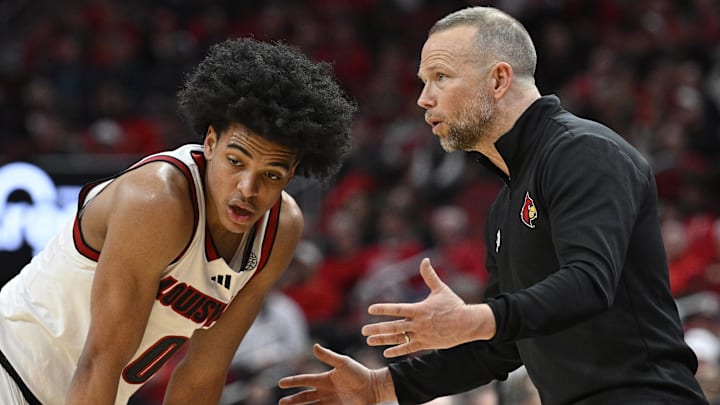
Pat Kelsey is one of the analytically-driven head coaches in college basketball, and as such, he has a natural sworn enemy: the mid-range jump shot. Just 2.7 percent of Louisville’s field goal attempts come from the mid-range (according to CBBanalytics.com), but after Monday night’s loss to No. 18 North Carolina in Chapel Hill, the No. 24 Cardinals’ second loss in three games, it might be time for that number to increase.
Louisville went 0-2 from mid-range on Monday night while hoisting 39 threes, a few more than the Cardinals’ season-long average of 32.9 three-pointers per game. While three is certainly more than two, and that math is irrefutable, Kelsey’s team is painfully predictable on the offensive end, and that has led to too many possessions where they come away with nothing.
While three is more than two, two is more than zero, and unless Louisville can find some offensive versatility, zero could be the number of games that it wins in the NCAA Tournament.
Louisville’s offensive predictability is a glaring Achilles heel heading into March
Not every team on Louisville’s schedule is going to have a rim protector like North Carolina center Henri Veesaar. However, just about every team can recreate some reasonable facsimile of Hubert Davis’s game plan for slowing down Louisville’s offense.
The Tar Heels didn’t necessarily run Louisville off the three-point line. That’s almost impossible to do. Kelsey’s offense is built to get at least 30 three-pointers up a night, if not more, and the 39 they hoisted on Monday were the most since a 104-47 win over NJIT back in November.
UNC did, however, contest nearly all of those threes, forcing the Cardinals to shoot 31.4 percent on above-the-break threes, and limited Louisville to just six percent of its field goal attempts coming from corner threes, down from 11.5 percent for the season. While that doesn’t seem like a massive drop, six percent would put Louisville in the bottom three percent of teams in the country this season, while 11 percent situates the Cardinals in the 79th percentile.
The corner three is the most efficient shot on the floor, so by taking that away, UNC made the 39 threes Louisville attempted considerably more difficult than its typical allotment. They could do that by closing out aggressively on shooters and staying glued to shooters in the corners because they were certain Louisville wouldn’t hurt them with mid-range pull-ups or floaters from the paint.
So, they funneled Louisville’s dribble-drives right to Veesaar, who, because Sananda Fru is 4-7 from three all season and Aly Khalifa is only attempting 1.9 threes a game, was waiting patiently at the rim. Veesaar didn’t record a single block, but in his 30 minutes, Louisville shot just 61.5 percent at the rim, down from 68.5 percent for the season, and a horrendous 2-8 from the paint.
For the game, Louisville shot 56.3 percent at the rim and 30 percent in the paint. Now, in fairness, UNC is one of the best rim-defending teams in the country, but that’s largely because of the Veesaar-Caleb Wilson duo, not Veesaar alone.
Either way, Louisville, and Mike Brown Jr. especially, continually passed up open looks in the mid-range and deferred floaters and push shots in the paint to test the seven-footer at the rim. Brown finished with 24 points on 9-25 shooting, and the Cardinals made just 12 two-point field goals all night and hardly got to the free-throw line, finishing 8-11 as they collapsed down the stretch.
Pat Kelsey can win big with his analytically-driven style, but not with this team
A tiger doesn’t change its stripes, so I wouldn’t expect Kelsey to suddenly embrace what analytics tell him is the least efficient shot in the sport. Also, he’s right to believe that, because it’s true and for all Louisville’s flaws, the Cardinals are 12th in offensive rating.
Also, you can win with a three-point-heavy style. Nate Oats has ridden it to a Final Four. However, Oats’s best teams have had either five-out spacing to stress rim-protecting bigs or a high-level lob-catching big, which is its own type of gravitational force. Right now, with Fru and Khalifa as its primary bigs, Louisville has neither.
Even then, Oats had Aaron Estrada as Mark Sears’ back-court running mate, and 12.3 percent of Estrada’s field goals in that 2024 postseason came from the mid-range, where he shot 50 percent.
If you’re going to play a threes-and-layups style, you need to have a counterpunch to punish teams when they leave you so much space in the mid-range and the paint. For Louisville, that likely has to be Mikel Brown Jr. if it’s not too late to integrate that into the superstar freshman’s repertoire.
 Add us as a preferred source on Google