

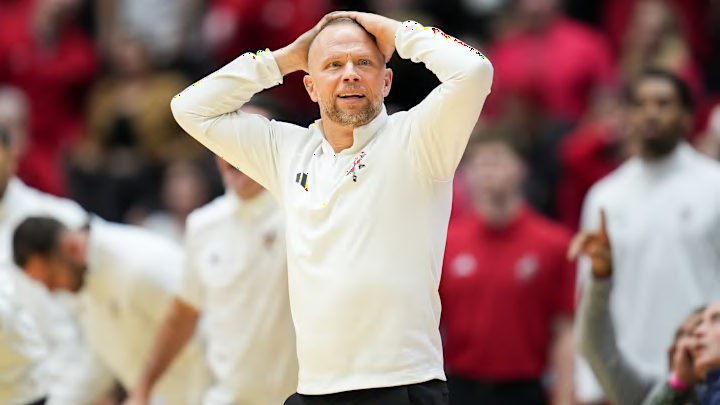
Louisville basketball opened the season ranked No. 11 in the AP Poll, its highest ranking since the 2019–20 season. That year, the Cardinals entered ranked No. 5 and finished No. 14, with the NCAA Tournament ultimately cancelled due to COVID. It left fans forever asking “what if.”
Louisville began this season with high hopes and legitimate Final Four aspirations, but the Cardinals now sit at 14–6, and the fans are sounding the alarms. Their best wins have come against Kentucky and Indiana, neither of which is currently ranked. Louisville has played four games against teams ranked as of today, plus one against Tennessee, which is technically ranked No. 26. The Cardinals are 0–5 in those games, losing by an average of 16.2 points per contest.
Pat Kelsey may preach that every practice and every game is the “most important” in the history of Louisville basketball, but the reality is simpler: these are the games that actually matter. When a team consistently plays its worst basketball against its best opponents, it is no longer a coincidence.
Related: Louisville basketball fans can’t ignore this glaring trend anymore under Pat Kelsey
Louisville's struggles against elite teams continue to concern Cardinals fans
Going 27–8 last season looks impressive on paper, especially when paired with an 18–2 ACC record and an appearance in the ACC Tournament championship game. But that record increasingly feels like fool’s gold. Including Monday night’s 31-point loss at Duke, Kelsey is now just 4–10 against ranked opponents during his tenure at Louisville. For fans dreaming of a Final Four run, that reality is hard to ignore.
Some coaches are known for building teams that peak in March and April. Mike Krzyzewski, Tom Izzo, Rick Pitino, and, as much as it pains Louisville fans to admit it, John Calipari all built reputations on having teams that could adapt and compete against elite opponents late in the season. That does not mean they won every year, but it does mean their teams were capable of adjusting. Coach K, for example, finished his career at Duke with a 238–155 (.606) record against ranked opponents. No one expects Pat Kelsey to be Coach K, but it is reasonable to expect better than 4–10.
With five of Louisville’s six losses coming against ranked teams this season, the sample size is large enough to dismiss the idea of simple “off nights.” In those five games, Louisville has averaged just 9.6 made three-pointers on 36.2 attempts, for a 26.5% shooting percentage. Meanwhile, their opponents have averaged 8.4 made threes on only 23.2 attempts per game, good for 36.2% shooting from deep.
The contrast against lesser competition is striking. In their other 15 games, Louisville averages 12.6 made threes per game on 33 attempts, shooting 38.2%. Opponents still average roughly the same number of three-point makes and attempts regardless of competition. The difference is Louisville’s own offensive output. Opponents are clearly adjusting their defenses against Kelsey’s system, and Louisville has yet to counter effectively.
The problems extend beyond shooting. In the five losses against ranked teams, Louisville has been outrebounded by an average margin of 42.2 to 33. They have been outscored in the paint 34 to 26.8 and in points off turnovers 15.4 to 6.4. Those are effort and physicality metrics, and they mirror the same issues that plagued Kelsey’s teams against quality opponents last season. Blaming the shooting alone ignores how thoroughly Louisville has been overpowered in nearly every phase of the game.
Kelsey’s identity is built on high energy, fast tempo, and high-volume scoring. He won over fans by promising a team that would play hard, play fast, and be competitive every night. That approach worked at Charleston and Winthrop, where his teams often had a clear talent advantage. At Louisville, that advantage does not exist. In a conference that includes Duke, North Carolina, and Virginia, Louisville frequently faces teams with equal or superior talent.
When you design a team to shoot the three at the highest rate of any of the 365 Division I programs, while also ranking last in two-point attempt rate, efficiency becomes non-negotiable. Louisville shoots 33.9 threes per game but converts them at just a 35.2% clip, ranking 112th nationally. That combination is simply not good enough to sustain success against elite competition.
Many fans hoped the return of Mikel Brown Jr. would provide a spark, particularly heading into Cameron Indoor Stadium. A win of that magnitude could have shifted the narrative and reignited hopes of a deep NCAA Tournament run. After a 31-point loss with Brown in the lineup, it is difficult to view him as a quick fix for the team’s systemic issues.
The calendar says Louisville is less than 70 days away from the National Championship game on April 6. With just 11 games remaining in the regular season, it is hard to imagine the Cardinals making the sweeping changes necessary to consistently compete with elite teams. The most realistic path forward is for Pat Kelsey to fully absorb the data and rethink how his teams approach ranked opponents.
If Louisville can make a run in the ACC Tournament and reach the second weekend of the NCAA Tournament, it would be a surprise at this point. Using the remainder of this season as a learning opportunity may ultimately prove more valuable. If those lessons are applied, perhaps Louisville fans can once again talk about Final Four aspirations in the seasons to come.
 Add us as a preferred source on Google