

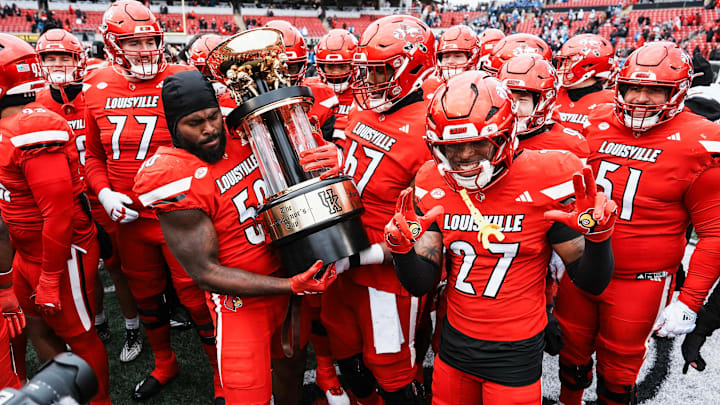
Louisville football fans have officially hit the summer sports debates section of the calendar year, where recurring discussions tend to rear their heads at least once each year. One such debate is not necessarily whether the Governor’s Cup should be played (which has been speculated to potentially come to an end in recent years). New Kentucky head coach Will Stein (and former Louisville quarterback) made comments recently that he not only desires to keep the rivalry going, but to also move the game back to the beginning of the season, as was the case for many years in the 1990s and 2000s.
Will Stein gives Louisville and Kentucky fans hope for the Governor's Cup future
The change from the beginning of the season to a mid and eventually late season placement has stemmed from multiple scheduling issues. When Louisville made the switch to the ACC in 2014, the game was placed in its current slot as the last game of the season during Rivalry Week. The recent comments from Stein have Louisville and Kentucky fans debating once again if the current placement is the absolute best spot for it.
Here are three reasons why the Governor’s Cup should be moved back to the beginning of the season.
3. Increased hype and excitement entering the season
The lead-up to this game, especially in the podcast- and enhanced-sports-talk-radio era, would be a massive day-in, day-out event as fans prepared for the start of the season. The moves and the hype surrounding not only the start of the season, but against arguably the biggest rival would make for great discussion throughout the last couple of months of the offseason.
Each summer is currently filled with plenty of excitement leading up to the season, from speculating final records to discussing the impact each player will provide to the team. However, having that first taste of new-season action against the rival team, instead of the likes of Eastern Kentucky, for example (yes, this upcoming season will be different, as the Cardinals will face Ole Miss) greatly increases the anticipation for Labor Day weekend.
2. National spotlight on the rivalry game
One of the best aspects of the Governor’s Cup being played in the first weekend of the season was that the game tended to be one of the major matchups of the weekend. With the game typically played on Sunday, it was often a standalone game, with many fans watching, craving any college football action on opening weekend. It was an opportunity for both teams to showcase their brands to a national audience and prove that the Governor’s Cup is one of the bitterest rivalries in all of college football.
In its current placement during Rivalry Week, the Governor’s Cup has to compete against the likes of Ohio St. vs Michigan, Auburn vs. Alabama, and Clemson vs. South Carolina (just to name a few) for air time and importance. Having to compete against some of the most storied college football rivalries not only takes eyes away from the product, but also diminishes the importance of the rivalry game to those outside of the Bluegrass state. Moving this game back to the beginning of the season alleviates any of these concerns and puts this rivalry back into the forefront of the national discussion.
1. Statement game to start the season
One of the major aspects of the Governor’s Cup when it was at the beginning of the season was that the result of the game set the tone for the rest of the season for both teams. Louisville had some of their most successful seasons started with major wins against the Wildcats. Kentucky also had the start of a special season when they knocked off the Cardinals in game 1.
No longer would the game at the end of the season be only played for bragging rights and pride. Louisville has thankfully handed Kentucky 2 blowout losses in the last couple of seasons, but both teams had their postseasons pretty well locked in by the start of the game. This game would be the first glimpse of both teams and give their respective fan bases insight into how their squads will perform for the rest of the season. The game would once again have real-time meaning year-round.
 Add us as a preferred source on Google